
Starting and growing a business is exciting, but it is also demanding. Startups and entrepreneurs often work in fast-moving environments where time is limited, resources are stretched, and every decision matters. On many days, the same founder may need to think about marketing, sales, planning, design, customer support, budgeting, operations, and product development all at once.
This is exactly why digital toolkits have become so valuable.
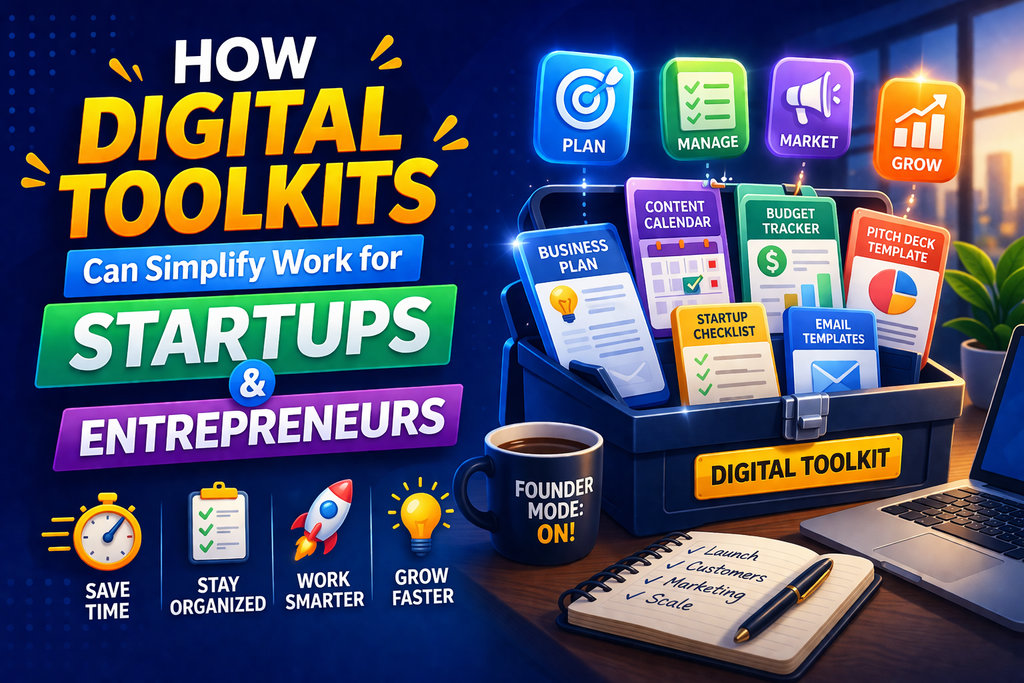
Digital toolkits help simplify work by giving startups and entrepreneurs a ready-to-use collection of tools, templates, systems, and resources that support daily business activities. Instead of building every workflow from scratch or managing work with scattered methods, business owners can use digital toolkits to organize tasks, save time, reduce stress, and operate more efficiently.
In today’s business environment, speed and clarity matter. Entrepreneurs need systems that help them move quickly without losing control. Digital toolkits make that possible by turning repeated business needs into structured, usable resources.
This article explores how digital toolkits can simplify work for startups and entrepreneurs, why they are so useful, and how they help businesses work smarter from the early stage through growth.
What Are Digital Toolkits?
Digital toolkits are collections of digital resources designed to help users perform specific tasks or manage particular areas of work more effectively. They may include templates, planners, worksheets, checklists, dashboards, presentations, workflows, calculators, documents, guides, and software-based systems.
A digital toolkit may focus on one part of business, such as:
- Marketing
- Sales
- Branding
- Hiring
- Productivity
- Finance
- Planning
- Content creation
- Customer onboarding
- Project management
Or it may combine multiple business functions into one larger productivity system.
Examples of digital toolkit elements include:
- Business plan templates
- Social media planning sheets
- Proposal templates
- Invoice templates
- Startup checklists
- Budget trackers
- Content calendars
- Sales scripts
- Pitch deck templates
- SOP documents
- Customer journey maps
- KPI dashboards
A digital toolkit is powerful because it turns scattered business work into a more structured system.
Why Startups and Entrepreneurs Need Simplicity
Startups and entrepreneurs often face a common problem: too much to do and too little time to manage it all clearly.
In early-stage business, people often operate without large teams or formal systems. This means important tasks can become messy, delayed, or inconsistent. A founder may be switching constantly between planning, execution, communication, and decision-making.
Without systems, this creates:
- Mental overload
- Repeated work
- Missed steps
- Slower execution
- Confusing workflows
- Lower consistency
- Unnecessary stress
Digital toolkits help simplify this environment by reducing the number of things a founder has to invent from scratch each day.
1. Digital Toolkits Reduce Repeated Work
One of the biggest ways digital toolkits simplify work is by reducing repetition.
Entrepreneurs often perform similar tasks again and again, such as:
- Sending proposals
- Planning social media content
- Tracking expenses
- Organizing client onboarding
- Reviewing goals
- Building launch plans
- Managing outreach
- Preparing presentations
Without a toolkit, these tasks may be recreated each time with new documents, new formats, or new mental effort. With a toolkit, the structure already exists.
This saves time and makes recurring business work more efficient.
2. They Help Organize Business Operations
Many startups struggle not because they lack good ideas, but because their operations are disorganized. Tasks live in different places, important files get lost, and processes depend too heavily on memory.
Digital toolkits help by bringing structure to business operations.
They can provide systems for:
- Daily task tracking
- Weekly planning
- Goal setting
- Team workflows
- Client delivery
- Budget monitoring
- Sales activity
- Marketing execution
This organized approach makes it easier to see what needs attention, what is already done, and what steps come next.
For startups, this kind of clarity is extremely valuable.
3. Digital Toolkits Save Time on Setup and Planning
Starting from a blank page takes more time than many people realize. A founder building a pricing sheet, launch checklist, onboarding email, or marketing calendar from scratch must decide structure, wording, sequence, and format every time.
Digital toolkits remove much of this setup burden.
Instead of asking:
- What should go in this document?
- How should I organize this workflow?
- What sections do I need?
- Where do I begin?
The toolkit already provides a starting point.
This reduces planning friction and makes it easier to move from idea to action quickly.
4. They Help Founders Focus on High-Value Work
Startups succeed when founders spend enough time on what truly matters: product quality, customer needs, sales, strategy, execution, and growth.
But in reality, many founders lose too much time to repeated administrative work and avoidable operational confusion.
Digital toolkits help reclaim that time.
By simplifying repeated work, they allow entrepreneurs to focus more on:
- Building offers
- Talking to customers
- Improving services
- Making decisions
- Solving real business problems
- Generating revenue
- Strengthening the brand
This matters because not every task deserves founder-level attention. Toolkits help lower-value repetition take less energy.
5. Digital Toolkits Improve Consistency
Consistency is important in every part of business. Inconsistent messaging, inconsistent client communication, or inconsistent workflow execution can weaken trust and create unnecessary mistakes.
Digital toolkits improve consistency by giving startups repeatable systems.
For example, a toolkit can ensure that:
- Every client gets the same onboarding process
- Every launch follows the same checklist
- Every proposal uses a strong structure
- Every marketing calendar follows a clear format
- Every team member works from the same base documents
This consistency helps startups look more professional and operate more smoothly, even with smaller teams.
6. They Make It Easier to Move Faster
Speed matters in startup environments. Businesses often need to test ideas, launch offers, adjust campaigns, respond to market feedback, and make progress without delay.
Digital toolkits support faster execution because they reduce decision fatigue and setup time.
Instead of building new systems every week, founders can plug into ready-made resources and keep moving.
This is especially useful when:
- Launching a new offer
- Preparing for investor conversations
- Running a promotion
- Hiring early team members
- Creating content consistently
- Setting up internal processes
- Managing customer delivery
Toolkits help transform speed from chaos into structured momentum.
7. Digital Toolkits Help Startups With Limited Teams
Many startups begin with just one founder or a very small team. In that environment, every person may handle multiple responsibilities.
A single person may manage:
- Marketing
- Customer support
- Sales follow-up
- Product development
- Admin work
- Financial tracking
- Content publishing
Digital toolkits are especially useful in these cases because they reduce the need for each team member to build everything independently.
They act like support systems for lean teams, helping them operate more effectively without needing a large operational department.
8. They Support Better Marketing Execution
Marketing is one of the most important growth functions for startups, but it can easily become scattered. Many entrepreneurs know they need to market consistently, but struggle to organize their content, campaigns, and messaging.
Digital marketing toolkits can simplify this.
They may include:
- Content calendars
- Caption templates
- Campaign planners
- Ad copy sheets
- Brand messaging guides
- Lead magnet checklists
- Email templates
- Launch timelines
These tools help entrepreneurs publish more consistently and market more strategically without needing to start from scratch every time.
9. Digital Toolkits Help With Sales and Client Management
Sales and client workflows are another area where digital toolkits are highly useful. Founders often lose time because they do not have structured systems for handling leads, proposals, onboarding, follow-up, or client communication.
A toolkit can help with:
- Discovery call notes
- Proposal documents
- Pricing sheets
- Follow-up email templates
- Client onboarding checklists
- Delivery workflows
- Feedback forms
- Renewal reminders
This makes sales and client management more organized and professional.
For service businesses, freelancers, consultants, and agency-style startups, this can be especially valuable.
10. They Simplify Internal Processes and SOPs
As startups grow, repeated internal tasks become more common. Without clear process documentation, small teams can easily become inefficient or inconsistent.
Digital toolkits can include simple SOPs, process sheets, and operational checklists that help businesses standardize routine activities.
This may cover:
- Content publishing steps
- Customer support process
- Team onboarding
- Weekly review workflow
- File naming conventions
- Lead response process
- Product delivery sequence
Even basic process documentation can make a startup much easier to manage.
Toolkits help create that documentation faster.
11. Digital Toolkits Can Reduce Stress and Mental Overload
Entrepreneurship often comes with heavy mental pressure. When everything depends on memory or constant decision-making, work becomes more stressful than it needs to be.
A well-built digital toolkit acts as an external system.
It helps entrepreneurs know:
- What to do
- What comes next
- What has already been completed
- What structure to follow
- Where important resources live
This reduces mental clutter and makes daily work feel more manageable.
In practical terms, digital toolkits do not just improve productivity. They can also improve peace of mind.
12. They Make Professionalism More Accessible
Not every startup has access to consultants, designers, strategists, or large internal teams. Digital toolkits help bridge that gap by giving founders access to professional-style systems and resources they can use immediately.
For example, a toolkit can help a startup present itself more professionally through:
- Better pitch decks
- Cleaner proposals
- Organized planning sheets
- Consistent brand content
- Clear customer processes
- More polished presentations
This matters because customers, clients, and partners often judge a business based on how organized and credible it appears.
Toolkits help smaller businesses present themselves with more confidence.
Common Types of Digital Toolkits Used by Startups and Entrepreneurs
Different business needs call for different toolkit categories.
Startup planning toolkits
These may include business model sheets, vision planners, milestone trackers, and goal-setting documents.
Marketing toolkits
These often include social media templates, brand guides, campaign calendars, launch checklists, and content systems.
Sales toolkits
These may feature pitch decks, proposal templates, follow-up sequences, and CRM-style lead tracking sheets.
Operations toolkits
These can include SOPs, workflow documents, internal checklists, and process templates.
Finance toolkits
These may include budget sheets, pricing calculators, cash flow trackers, and expense planning templates.
Productivity toolkits
These usually help with daily planning, time management, project tracking, and weekly reviews.
The most effective toolkit is usually the one that solves the most repeated pain points in the business.
What Makes a Good Digital Toolkit?
Not every toolkit simplifies work equally. A good digital toolkit should be practical, relevant, and easy to use.
The best toolkits usually have these qualities:
Clear purpose
The user should quickly understand what problem the toolkit solves.
Simple organization
Files and sections should be easy to navigate.
Real usefulness
The toolkit should support actual repeated work, not just look impressive.
Easy customization
Users should be able to adapt it to their own business needs.
Time-saving structure
It should reduce effort, not add complexity.
Professional quality
Templates, layouts, and systems should feel polished and reliable.
A toolkit should create action, not confusion.
Do Digital Toolkits Replace Strategy?
No. A toolkit is not a substitute for thinking. It does not automatically build a great business or make decisions for the founder.
What it does is support strategy by making execution easier.
A founder still needs to understand the market, define the offer, speak to customers, and make good business decisions. The toolkit simply helps carry out repeated work more smoothly.
In this sense, digital toolkits do not replace intelligence or leadership. They strengthen them by reducing friction.
Challenges to Keep in Mind
Digital toolkits are powerful, but they must fit the business well.
Common mistakes include:
- Using too many tools at once
- Choosing complex systems that slow work down
- Relying on generic templates without adaptation
- Downloading resources that do not match actual workflow needs
- Overorganizing instead of executing
The best toolkit is usually not the biggest. It is the one that gets used consistently and supports real progress.
Why Digital Toolkits Will Continue to Grow in Importance
As entrepreneurship becomes more digital and competitive, founders need ways to move faster without becoming disorganized. Startups especially need systems that support action without requiring large teams or heavy overhead.
Digital toolkits meet this need well because they offer:
- Efficiency
- Structure
- Reusability
- Clarity
- Professionalism
- Scalability
They are likely to become even more valuable as more entrepreneurs build lean businesses, remote teams, digital brands, and online-first startups.
Final Thoughts
Digital toolkits can simplify work for startups and entrepreneurs by reducing repeated effort, organizing operations, improving consistency, and helping founders move faster with less chaos.
They support marketing, sales, planning, client management, operations, and productivity by turning scattered business tasks into repeatable systems. For lean startups and busy entrepreneurs, that kind of structure is not just helpful. It can be a major advantage.
In the early stages of business, simplicity is powerful. The more clearly a founder can operate, the more energy they can direct toward growth, customers, and results.
That is why digital toolkits are becoming such important tools for modern startups and entrepreneurs.
Comments (0)