
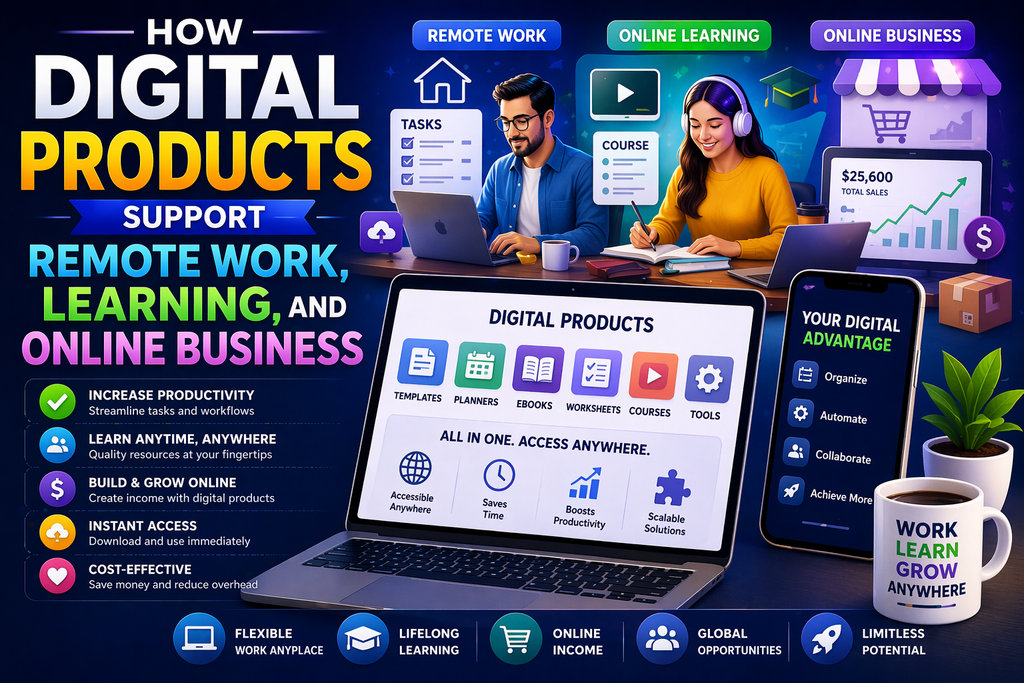
The modern world is increasingly built around digital access. People now work from home, study from anywhere, build businesses online, collaborate across countries, and manage important parts of life through devices and internet-based systems. In this environment, digital products have become far more than convenient downloads or optional extras. They have become essential tools that help people function, grow, and succeed in remote and online environments.
Whether it is a course, template, planner, ebook, worksheet, design asset, dashboard, software tool, or digital workspace, a digital product can save time, improve clarity, and make work or learning more accessible. These products help people organize tasks, communicate ideas, teach skills, build systems, and deliver value without depending on physical presence.
This is why digital products now play such an important role in remote work, online learning, and digital business. They help convert knowledge, structure, and utility into something instantly usable from anywhere.
This article explores how digital products support remote work, learning, and online business, why they have become so important, and how they continue to shape the future of productivity and growth.
What Are Digital Products?
Digital products are items created, delivered, and used in digital form. Unlike physical products, they do not require shipping, storage, or physical handling in the traditional sense. They can be downloaded, accessed online, shared through links, or used within apps and digital platforms.
Common digital products include:
- Ebooks
- Online courses
- Templates
- Worksheets
- Digital planners
- Stock photos and videos
- UI kits
- Mockups
- Spreadsheets
- Dashboards
- Software tools
- Plugins
- Membership content
- Checklists
- Digital workspaces
What makes digital products especially valuable is that they can often be created once and used many times, by many people, across different locations.
Why Digital Products Matter More in a Connected World
As work and learning move further into digital spaces, people need resources that match that flexibility. Traditional systems often depended on physical presence, printed materials, office-based tools, or local access. Digital products remove many of those limitations.
They matter because they help people:
- Work from anywhere
- Learn at their own pace
- Build businesses without physical inventory
- Share knowledge globally
- Collaborate more easily
- Save time through reusable systems
- Reduce operational friction
This makes digital products deeply relevant to how modern people work, study, and create value.
How Digital Products Support Remote Work
Remote work depends on clarity, systems, communication, and self-management. Without the structure of a shared physical office, workers and teams need digital tools that help keep work organized and visible.
Digital products play a major role in making remote work practical and sustainable.
1. They help organize tasks and workflows
In remote work, task organization becomes even more important because people are often working independently across different times and locations.
Digital products such as planners, project templates, dashboards, and digital workspaces help remote workers:
- Track daily responsibilities
- Manage deadlines
- Organize ongoing projects
- Prioritize work clearly
- Review progress regularly
These tools reduce confusion and help remote professionals stay aligned with goals and expectations.
2. They reduce dependence on physical office systems
In office-based work, many workflows rely on physical environments, such as whiteboards, printed schedules, in-person meetings, or desk-based filing systems. Digital products replace or improve many of these systems.
For example:
- Spreadsheet templates replace manual trackers
- Digital planners replace paper notebooks
- Project boards replace physical wall planning
- Shared templates replace scattered files
- Digital dashboards replace informal office updates
This makes remote work more manageable and less dependent on physical infrastructure.
3. They improve productivity through reusable systems
Remote workers often need repeatable systems to stay efficient. Without a shared office routine, simple things can take more effort unless structure already exists.
Digital products support productivity by providing reusable resources such as:
- Meeting note templates
- Weekly planning sheets
- Task dashboards
- Proposal templates
- Content calendars
- Time trackers
- Reporting sheets
These products help workers spend less time rebuilding routine workflows and more time on valuable work.
4. They support asynchronous work
Remote teams are often distributed across time zones. This means people may not always be online at the same time. Digital products help support asynchronous work by making information easier to access without requiring live explanation.
Examples include:
- SOP documents
- Recorded training modules
- Shared workspaces
- Knowledge bases
- Process templates
- Internal resource libraries
These resources allow team members to understand tasks and systems on their own schedule, which is critical for modern remote work.
5. They help remote professionals maintain clarity and control
When work happens from home or across locations, mental clutter can increase quickly. A digital product such as a daily dashboard, weekly planner, or personal work tracker gives the user a clearer sense of direction.
This can help with:
- Focus
- Time awareness
- Goal tracking
- Work-life organization
- Reduced stress
- Better planning habits
In remote environments, this kind of structure matters a lot.
How Digital Products Support Learning
Online and flexible learning have expanded dramatically. Students, professionals, self-learners, and organizations now depend on digital resources to build knowledge without being tied to classrooms or physical libraries.
Digital products have made learning more accessible, flexible, and scalable.
6. They make learning accessible from anywhere
One of the biggest strengths of digital products in education is accessibility. A learner can access an ebook, course, worksheet, or guide from almost anywhere with a device and internet connection, or sometimes even offline after download.
This helps remove barriers related to:
- Geography
- Physical availability
- Shipping delays
- Classroom limitations
- Fixed schedule dependency
As a result, learning becomes more reachable for more people.
7. They support self-paced education
Not everyone learns at the same speed. Some learners need time to revisit concepts, while others prefer to move quickly. Digital products make this possible.
Courses, worksheets, ebooks, revision tools, and digital notes help learners:
- Study when they are ready
- Repeat difficult sections
- Review key ideas multiple times
- Learn at a comfortable pace
- Pause and return when needed
This self-paced flexibility is one of the most important benefits of digital learning products.
8. They turn knowledge into structured resources
Digital learning works best when information is organized clearly. Digital products like courses, study planners, worksheets, templates, and guides help transform raw information into a structured learning path.
This helps learners understand:
- What to study
- In what order
- What to practice
- How to track progress
- What to revise next
That structure is especially important in online learning, where the learner may not always have direct instructor guidance in real time.
9. They support active learning, not just passive reading
Good digital learning products often go beyond simple reading. Worksheets, quizzes, exercises, practice sheets, flashcards, and interactive templates encourage learners to engage actively.
This can improve:
- Understanding
- Memory
- Skill development
- Confidence
- Real application of knowledge
A worksheet or guided workbook, for example, helps the learner do something with the material instead of only reading it.
10. They help teachers and educators teach more effectively online
Digital products are not only useful for learners. They also help educators.
Teachers, tutors, and trainers can use digital products to provide:
- Course lessons
- Downloadable resources
- Practice material
- Assessment sheets
- Class notes
- Visual aids
- Lesson plans
- Learning dashboards
This helps educators deliver better support even when teaching remotely or asynchronously.
How Digital Products Support Online Business
Online business is built on digital delivery, digital communication, and digital customer experience. This makes digital products especially important not only as business tools, but often as business models themselves.
11. They help entrepreneurs build businesses without physical inventory
One of the strongest business advantages of digital products is that they do not require physical stock in the same way traditional products do.
An entrepreneur can sell:
- Templates
- Ebooks
- Courses
- Printables
- Design assets
- Software tools
- Planners
- Resource bundles
This reduces overhead related to manufacturing, storage, and shipping. It allows businesses to start leaner and scale faster.
12. They support faster content creation and marketing
Online businesses depend heavily on content and communication. Digital products such as templates, stock assets, mockups, spreadsheets, and content systems help businesses publish and market more efficiently.
They support:
- Social media creation
- Email campaigns
- Sales pages
- Product listings
- Blog visuals
- Presentation design
- Lead magnets
- Promotional graphics
This helps online brands stay active and visible without creating everything from zero each time.
13. They make service delivery more scalable
For coaches, consultants, freelancers, agencies, and educators, digital products can strengthen or extend service delivery.
For example, a business can use digital products to offer:
- Onboarding kits
- Client workbooks
- Templates
- Training modules
- Resource libraries
- Self-service guides
- Dashboards and trackers
This makes service businesses more scalable because not every part of value delivery has to happen through one-to-one time.
14. They help businesses systemize operations
Online businesses often grow faster when they create repeatable systems. Digital products support this by providing ready-made frameworks for common tasks.
Examples include:
- Sales trackers
- Content calendars
- CRM sheets
- Launch checklists
- Budget templates
- SOP documents
- Team planning boards
- Client management resources
These resources reduce operational chaos and help businesses run with more consistency.
15. They make global reach easier
A physical business often depends on location. Digital products can be sold, delivered, and used across borders with far fewer limitations.
This means creators and businesses can serve:
- International students
- Global customers
- Remote teams
- Worldwide niche communities
- Cross-border professional audiences
That global accessibility is one reason digital products are so valuable in online business models.
How Digital Products Create Flexibility Across All Three Areas
One of the biggest reasons digital products matter is that they support flexibility across remote work, learning, and online business at the same time.
They allow people to:
- Access tools when needed
- Customize systems to their workflow
- Reuse assets repeatedly
- Learn on demand
- Work independently
- Scale value digitally
- Collaborate without physical limits
This makes digital products not just useful in one category, but powerful across multiple areas of modern life.
Examples of Digital Products Used in Remote Work, Learning, and Business
Different types of digital products support different goals.
For remote work
- Project planners
- Task dashboards
- SOP documents
- Meeting templates
- Time trackers
- Team workspaces
For learning
- Ebooks
- Courses
- Worksheets
- Flashcards
- Study planners
- Revision notes
For online business
- Templates
- Mockups
- Design assets
- Marketing kits
- Sales dashboards
- Resource bundles
- Digital toolkits
Many digital products also overlap across categories. A spreadsheet template might be useful for both learning and business. A workspace template might support both remote teams and online creators.
Why These Products Are So Scalable
Digital products are especially powerful because they can often be used repeatedly without needing to be recreated each time.
This makes them scalable in several ways:
- One creator can serve many users
- One business can sell the same product many times
- One team can reuse a system across projects
- One learner can revisit a product repeatedly
- One resource can support multiple use cases
This scalability increases both practical value and business potential.
What Makes a Useful Digital Product in These Contexts?
Not every digital product is equally valuable. The most useful ones usually share a few common qualities.
Clarity
The product should be easy to understand and use.
Relevance
It should solve a real need related to work, learning, or business.
Structure
It should help organize information or action clearly.
Accessibility
It should be easy to access across common devices.
Reusability
It should support repeated use or long-term value.
Practicality
It should help users do something better, faster, or more confidently.
A digital product becomes truly useful when it reduces friction in real life.
Challenges to Keep in Mind
Digital products are powerful, but they are not automatically effective. Poorly designed products, overcomplicated systems, or irrelevant resources can create confusion instead of solving problems.
Common issues include:
- Too much complexity
- Weak organization
- Generic content without real usefulness
- Poor compatibility with user workflow
- Lack of customization options
- Over-reliance on tools without clear purpose
The best digital products are usually the ones that stay simple, focused, and relevant.
Why Their Importance Will Continue to Grow
Remote work, online learning, and internet-based business are not temporary trends. They are increasingly part of how the world operates.
As these areas continue to grow, so will the need for digital products that help people:
- Stay organized
- Learn effectively
- build scalable systems
- communicate clearly
- work independently
- manage digital operations better
That is why digital products are likely to become even more important in the years ahead.
Final Thoughts
Digital products support remote work, learning, and online business by making modern digital life more organized, flexible, and scalable.
They help remote workers manage tasks and workflows. They help learners access knowledge and practice at their own pace. They help entrepreneurs and online businesses deliver value, market effectively, and build systems without heavy physical overhead.
More importantly, digital products turn information, structure, and utility into practical tools people can use from anywhere. That is what makes them so powerful in the modern world.
As work, learning, and business continue to evolve online, digital products will remain some of the most important tools helping people adapt, grow, and succeed.
Comments (0)